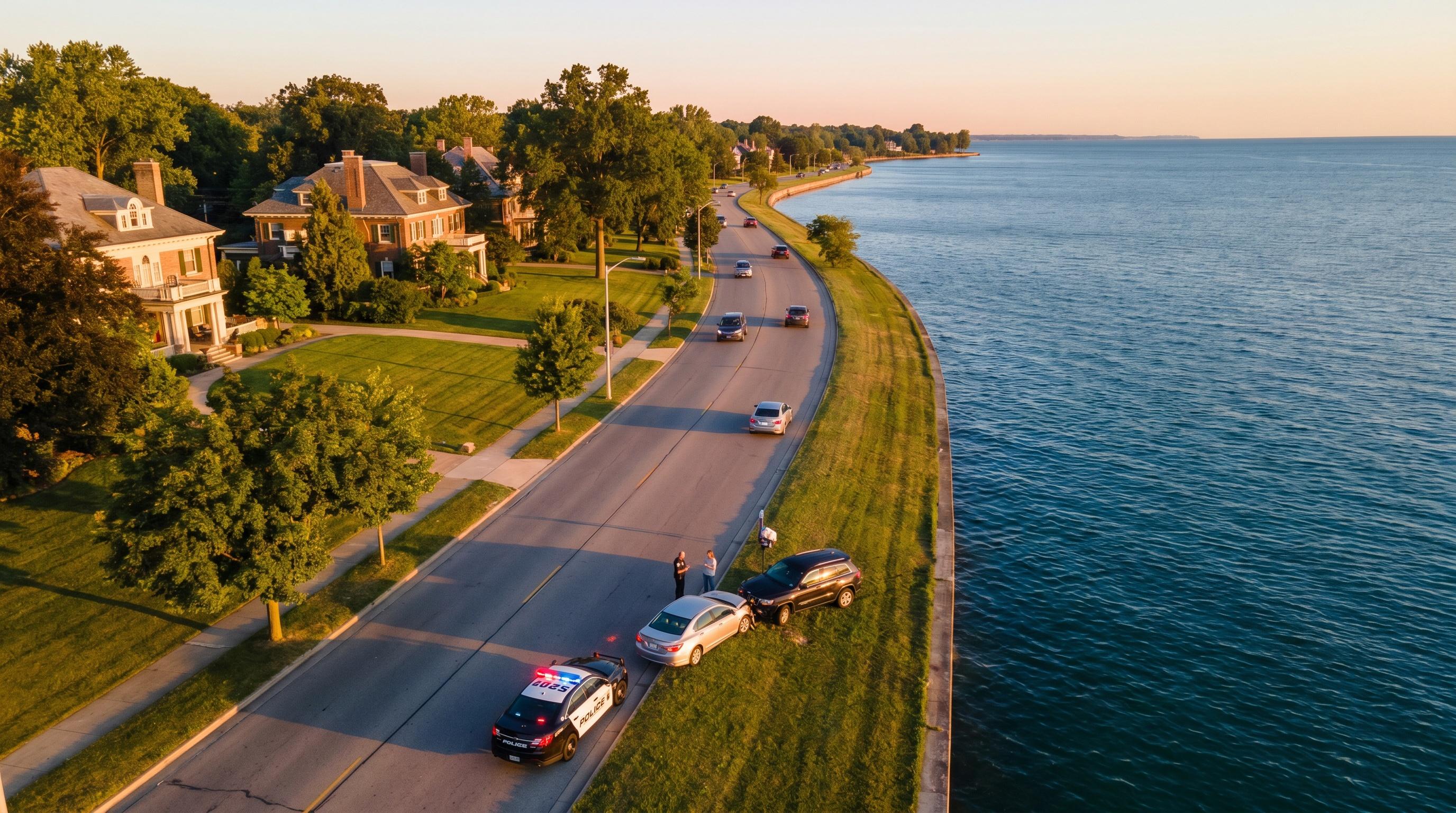
In July 2024, Governor Mike DeWine designated the eight-mile stretch of Interstate 90 running through Bratenahl and Cleveland as Ohio's first Speed & Seat Belt Safety Corridor. This unprecedented action was a direct response to a staggering reality: since 2021, this specific corridor has seen 413 crashes involving excessive speed and 27 fatal accidents. If you have been injured in a Bratenahl car accident, you are dealing with a uniquely dangerous stretch of highway, aggressive insurance adjusters, and a complex local legal system. You need immediate, authoritative guidance to protect your right to compensation.
The Reality of Bratenahl Car Accidents and I-90 Dangers
Bratenahl is a small village geographically surrounded by the City of Cleveland and Lake Erie, but it contains one of the most heavily trafficked and dangerous sections of Interstate 90 in Northeast Ohio. The combination of high-speed commuter traffic, sudden lake-effect weather conditions, and the transition into the infamous Dead Man's Curve creates a volatile environment for drivers. In 2024 alone, Cuyahoga County recorded 111 fatal urban traffic crashes, a significant increase from previous years. The Ohio State Highway Patrol (OSHP) and the Bratenahl Police Department have aggressively increased enforcement in this area, issuing hundreds of citations for speed and seat belt violations.
Despite the new safety corridor designation, which successfully reduced total crashes from 406 to approximately 311 in its first year, severe collisions remain a daily threat. When a crash occurs on I-90 or local routes like Lakeshore Boulevard, the physical and financial devastation can be overwhelming. Victims often face catastrophic injuries, mounting medical bills at facilities like the Cleveland Clinic or University Hospitals, and immediate pressure from insurance companies desperate to minimize their financial exposure.
The geography of Bratenahl itself contributes to the unique hazards drivers face. The village is nestled tightly against Lake Erie, meaning that during the winter months, sudden whiteout conditions and black ice can form rapidly on the elevated sections of the Shoreway. These weather events drastically reduce visibility and traction, leading to devastating multi-vehicle pileups. Even in clear weather, the sheer volume of traffic merging onto and off of I-90 at high speeds creates constant friction points where rear-end collisions and sideswipes are frequent occurrences.
Furthermore, the transition from the high-speed interstate into the slower, residential streets of Bratenahl, such as Bratenahl Road and Brighton Road, often catches drivers off guard. Motorists exiting the highway frequently fail to adjust their speed appropriately, leading to dangerous intersection collisions. The Bratenahl Police Department maintains a strict enforcement presence, but they cannot prevent every negligent act. When another driver's carelessness shatters your life, understanding the specific dynamics of where and how the crash occurred is the first step in building a compelling case for compensation.
Understanding Bratenahl Traffic Ordinances and Liability
Establishing fault after a Bratenahl car accident requires a precise understanding of both state law and local municipal codes. The Bratenahl Police Department, located at 411 Bratenahl Road, enforces specific local ordinances that frequently dictate liability in civil personal injury claims. For example, Bratenahl Codified Ordinance § 333.03 governs maximum speed limits and the critical "assured clear distance ahead" rule. A driver who rear-ends your vehicle on I-90 because they failed to maintain a safe following distance has violated this ordinance, establishing clear liability for your injuries.
Bratenahl strictly enforces laws regarding reckless operation and hit-and-run offenses. Under Bratenahl Codified Ordinance § 333.02, operating a vehicle in willful or wanton disregard of safety is a serious offense. If a driver flees the scene of a crash on Lakeshore Boulevard, they violate Bratenahl Codified Ordinance § 335.12 and Ohio Revised Code Section 4549.02. In personal injury litigation, proving that the at-fault driver violated these specific safety statutes constitutes negligence per se, meaning the violation itself establishes their breach of duty to you as a fellow motorist.
Another critical local regulation is Bratenahl Codified Ordinance § 333.031, which mandates how drivers must approach a stationary public safety, emergency, or road service vehicle. This "Move Over" law is heavily enforced, especially given the frequent presence of OSHP troopers and Bratenahl police officers conducting traffic stops within the safety corridor. If a driver fails to move over or slow down and strikes your disabled vehicle or an emergency responder, their violation of this ordinance serves as powerful evidence of their negligence.
The interplay between these local ordinances and broader Ohio state law forms the foundation of any successful personal injury claim arising from a Bratenahl crash. Your attorney must meticulously analyze the police report, identify every citation issued to the at-fault driver, and leverage those violations to prove liability. The insurance company will attempt to downplay the significance of a traffic ticket, arguing that a citation does not automatically equal civil liability. However, a skilled trial attorney knows how to use these local ordinance violations to dismantle the insurer's defenses and establish a clear narrative of negligence.
The Adversarial Reality of Insurance Claims in Ohio
After a crash in Bratenahl, you are immediately thrust into an adversarial system. The at-fault driver's insurance company will assign an adjuster to your claim within hours. This adjuster is not your advocate; their explicit job is to protect the insurance company's profit margins by paying you as little as possible. They are trained to use recorded statements to twist your words, request sweeping medical authorizations to blame your pain on pre-existing conditions, and offer rapid, low-ball settlements before you understand the full extent of your injuries.
Ohio law provides specific protections, but you must know how to enforce them. Under Ohio Revised Code Section 2315.33, Ohio follows a modified comparative fault rule. This means you can recover damages as long as you are 50 percent or less at fault for the crash. However, if an insurance adjuster successfully shifts 51 percent of the blame onto you, your financial recovery is completely barred. You cannot afford to fight this battle alone while trying to heal from severe injuries.
The tactics used by insurance adjusters are sophisticated and relentless. They will scour your social media accounts looking for any photograph or post that contradicts your injury claims. They will hire private investigators to conduct surveillance, hoping to catch you performing a physical activity that they can use to argue you are exaggerating your pain. They will delay responding to your calls, hoping that mounting financial pressure will force you to accept a fraction of what your claim is truly worth. This is not a system designed for fairness; it is a system designed for attrition.
Furthermore, insurance companies operate under the legal framework of Ohio Revised Code Section 3901.21, which outlines their good faith obligations. However, proving bad faith is a complex legal hurdle. You need an attorney who understands how to hold these corporations accountable, forcing them to negotiate fairly or face the prospect of a costly trial in the Cuyahoga County Court of Common Pleas. The moment you retain legal counsel, the dynamic shifts. The adjuster can no longer contact you directly, and they know they are dealing with a professional who understands the true value of your claim.
The Critical Role of Medical Evidence and Documentation
Winning a personal injury claim in Cuyahoga County requires more than just proving the other driver was at fault; you must definitively prove the extent and cause of your injuries. This requires immediate and consistent medical documentation. If you are involved in a high-speed collision on the I-90 safety corridor, you must seek emergency medical evaluation immediately, even if you believe your injuries are minor. Adrenaline masks pain, and conditions like traumatic brain injuries or internal bleeding may not present severe symptoms until hours or days later.
When you are transported to a Level 1 Trauma Center like the Cleveland Clinic Main Campus or University Hospitals Cleveland Medical Center, the medical records generated during that initial visit form the bedrock of your claim. These records establish a direct temporal link between the crash and your injuries, a link the insurance company will desperately try to sever. If you delay seeking treatment, the adjuster will argue that your injuries were caused by an intervening event or that they are simply not as severe as you claim.
Following your initial emergency care, you must adhere strictly to the treatment plan prescribed by your physicians. Missing physical therapy appointments, failing to fill prescriptions, or ignoring referrals to medical experts provides the insurance company with ammunition to argue that you are not mitigating your damages. In Ohio, plaintiffs have a legal duty to mitigate their damages, meaning you must take reasonable steps to recover from your injuries. Failing to do so can significantly reduce the compensation you are entitled to receive.
Your attorney will work closely with your medical providers to ensure that your injuries are thoroughly documented and that the long-term implications of those injuries are fully understood. This often involves consulting with medical experts, vocational rehabilitation professionals, and economists to project your future medical needs and lost earning capacity. A severe crash in Bratenahl can alter the trajectory of your life permanently; your compensation must reflect that reality, not just the immediate out-of-pocket expenses.
Navigating Uninsured and Underinsured Motorist Claims
One of the most frustrating realities of driving in Northeast Ohio is the high number of uninsured motorists on the road. If you are struck by a driver who has no insurance, or whose insurance limits are insufficient to cover your catastrophic injuries, you must turn to your own auto insurance policy. Uninsured and Underinsured Motorist (UM/UIM) coverage is governed by Ohio Revised Code Section 3937.18, and navigating these claims is notoriously complex.
Ohio is a "limits-to-limits" state regarding UIM coverage. This means your UIM coverage does not stack on top of the at-fault driver's liability limits; rather, it fills the gap between their limits and your own. For example, if the at-fault driver has the Ohio state minimum liability coverage of $25,000, and your injuries total $100,000, you can only recover the remaining $75,000 from your own UIM policy if your UIM limits are at least $100,000. If your UIM limits are also $25,000, you will recover nothing from your own policy.
Filing a UM/UIM claim means you are now in an adversarial relationship with your own insurance company. The company you have paid premiums to for years will suddenly treat you with the same suspicion and hostility as the at-fault driver's insurer. They will demand recorded statements, scrutinize your medical records, and attempt to minimize your payout. You must approach a UM/UIM claim with the same level of legal rigor and preparation as a third-party liability claim.
Your attorney will review your insurance policy meticulously to identify all available avenues of recovery. This includes examining the policy language for any exclusions or limitations that the insurer might attempt to use to deny coverage. In cases involving severe injuries, identifying every potential source of insurance coverage is critical to ensuring you receive the financial support necessary to rebuild your life.
Protect Your Claim Before Evidence Disappears
The insurance company is already building a case against you. You need an experienced Cleveland personal injury attorney to secure the crash report from the Bratenahl Police, preserve vital evidence, and stop the adjuster's manipulative tactics.
Do not let the two-year statute of limitations expire on your Cuyahoga County claim. Call Ryan Injury Attorneys today for a free, confidential consultation.
Frequently Asked Questions
How long do I have to file a lawsuit after a Bratenahl car accident?
Under Ohio Revised Code Section 2305.10, you have exactly two years from the date of the accident to file a personal injury lawsuit. If you miss this strict deadline, you permanently lose your right to seek compensation, regardless of how severe your injuries are or how clearly the other driver was at fault. For wrongful death claims, the deadline is two years from the date of the victim's death under O.R.C. § 2125.02.
How do I get my crash report from the Bratenahl Police Department?
You can request your accident report directly from the Bratenahl Police Department by calling 216-681-1234 or emailing their records division. If your crash was investigated by the Ohio State Highway Patrol on I-90, you must request the report from the OSHP Cleveland Post (216-587-5506). Securing this report immediately is critical, as it contains the responding officer's initial assessment of fault and citations issued under Bratenahl ordinances.
What if the at-fault driver who hit me on I-90 does not have insurance?
If you are hit by an uninsured driver, you must turn to your own auto insurance policy's Uninsured/Underinsured Motorist (UM/UIM) coverage, governed by Ohio Revised Code Section 3937.18. Ohio is a "limits-to-limits" state, meaning your UIM coverage fills the gap between the at-fault driver's limits and your own policy limits. An attorney can help you navigate this complex first-party claim to ensure your own insurer honors their contractual obligations.
Will my case go to the Bratenahl Mayor's Court?
No. The Bratenahl Mayor's Court only handles minor misdemeanor traffic offenses and local ordinance violations, such as speeding tickets issued in the safety corridor. If you are filing a civil personal injury lawsuit seeking financial compensation for your injuries, your case will be filed in the Cuyahoga County Court of Common Pleas in downtown Cleveland. Smaller claims may occasionally be filed in the Cleveland Municipal Court.
What if the insurance adjuster says the crash was partially my fault?
Insurance adjusters frequently use Ohio's modified comparative fault law (O.R.C. § 2315.33) as a weapon to reduce your payout. If they claim you were 20 percent at fault, they will reduce your settlement offer by 20 percent. If they can argue you were 51 percent at fault, they pay nothing. You must never accept an adjuster's determination of fault; an experienced attorney will independently investigate the crash using Bratenahl police data and accident reconstruction to prove the other driver's liability.
Does the new I-90 Speed & Seat Belt Safety Corridor affect my personal injury claim?
Yes, the designation of the I-90 corridor through Bratenahl significantly impacts the evidentiary landscape of your claim. Because this area is subject to intense enforcement by the OSHP and Bratenahl Police, there is a higher likelihood that the at-fault driver received a citation for excessive speed or reckless operation. A citation issued within this highly monitored zone provides powerful evidence of negligence per se, strengthening your demand for full compensation.
What should I do if the insurance company offers me a settlement check immediately?
You must reject any early settlement offer and refuse to sign any release forms until you have consulted with an attorney. Insurance companies offer rapid settlements to close the claim before you realize the full extent of your medical expenses and future care needs. Once you sign a release and accept that check, you forfeit your right to pursue any further compensation, even if your injuries require surgery months later.