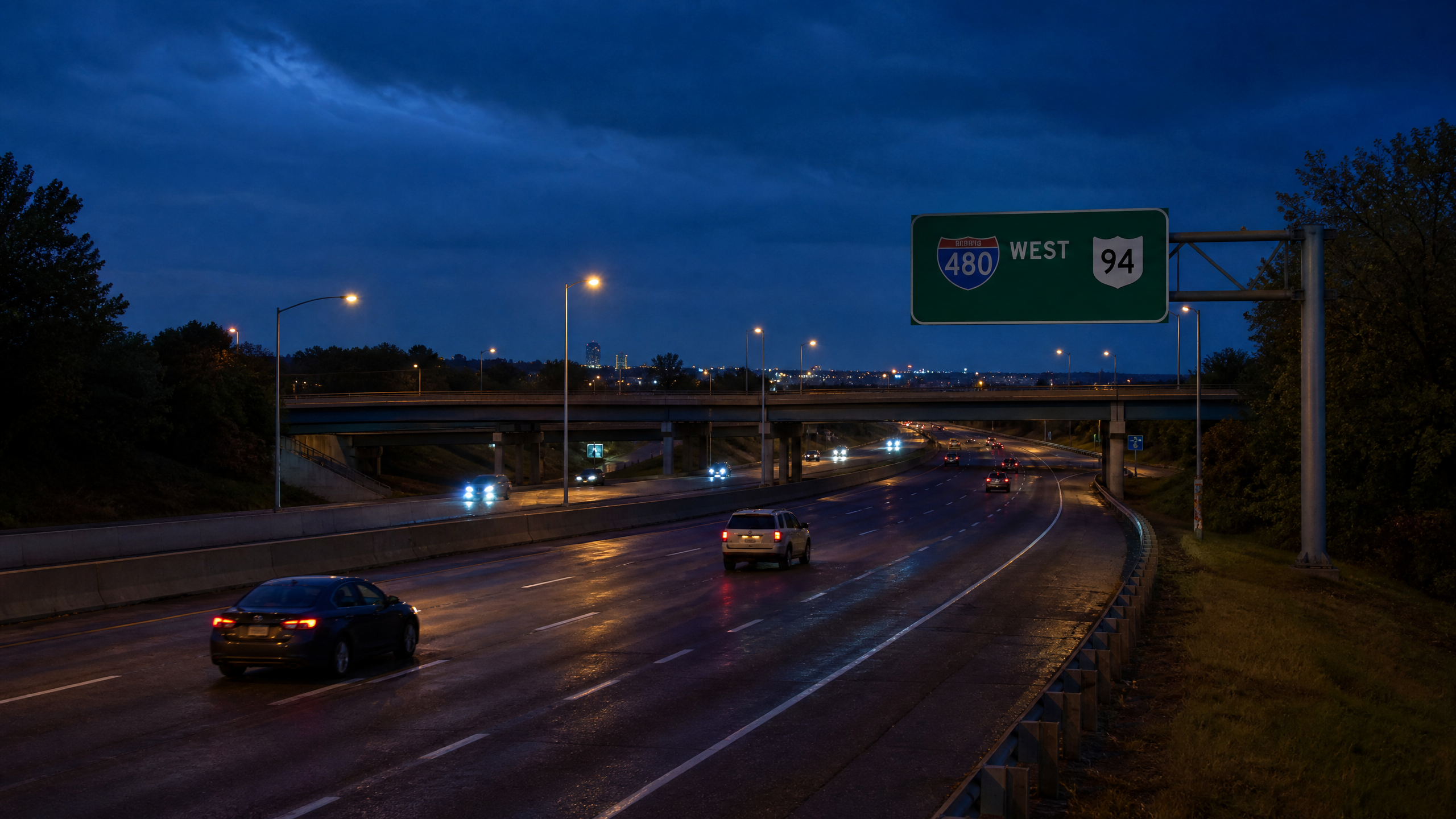
Five people were transported to a Cleveland hospital after a reported three-car crash on I-480 West at State Route 94. One vehicle overturned, the Ohio State Highway Patrol responded, and the westbound lanes experienced closures and traffic backups for more than an hour before the scene cleared. For anyone affected by a serious Cleveland highway collision, the first priorities are medical care, accurate records, and a careful approach to the facts that remain under investigation.
The featured image is an original illustrative view of I-480 West near State Route 94. It provides roadway context only and does not depict the reported collision, its vehicles, or the people involved.
What Local Reporting Confirms About the I-480 West Crash
WKYC reported that the crash occurred Tuesday evening on I-480 West at State Route 94 in Cleveland. The Cleveland fire department confirmed that three vehicles were involved and that one vehicle flipped. Five people, identified in the report as an adult man, an adult woman, and a family of three, were taken to a Cleveland hospital by EMS. The report also stated that the conditions of those individuals had not been made public.
According to the same report, the collision caused lane closures and traffic backups for more than an hour. The Ohio Department of Transportation reported that the scene cleared shortly before 7:45 p.m. One driver was reported to be operating a rideshare vehicle, but the riders in that vehicle did not require medical attention. The available reporting does not identify a cause, assign fault, report citations, or explain the severity of any injury. Read the WKYC report.
Why a Three-Car Crash on I-480 Requires More Than a Quick Fault Assumption
Interstate 480 is a major Cuyahoga County corridor that carries commuter, commercial, airport, and local traffic through Greater Cleveland. When several vehicles are involved, the public often sees only the final position of the cars, an image of an overturned vehicle, or a short traffic alert. Those facts can explain why the crash drew a response. They do not explain the sequence of events that produced it.
In a multi-vehicle collision, the evidence may include the crash report, vehicle damage, photographs, roadway markings, witnesses, available traffic-camera footage, dispatch records, and electronic data maintained by a vehicle or rideshare platform. A driver may describe a sudden stop, a lane change, an obstructed view, or another event that is not apparent from the roadway after the scene is cleared. That is why no one should treat an early news account as a final liability finding.
The reported I-480 collision involved an overturned vehicle, but an overturn by itself does not establish that any particular person acted negligently. The Ohio State Highway Patrol response is important because the official investigation may document observations that are not included in a news update. A person with a potential claim should preserve information early, while physical and electronic evidence is still available.
What to Do in the First Days After a Serious Cleveland Highway Collision
Medical care comes first. Some collision-related symptoms are visible at the scene, while others become clearer after the initial shock fades. Following the instructions of emergency personnel, attending follow-up appointments, and keeping medical paperwork can help an injured person make informed decisions about treatment and document what occurred.
Once immediate safety needs are addressed, the next task is preserving reliable information. Memory can become less precise as time passes, particularly after an unexpected highway crash. The following steps are practical for a person who is able to take them or for a family member helping after the collision.
- Keep the report information. Record the investigating agency, report number, date, and location. For this crash, local reporting identified the Ohio State Highway Patrol as a responding agency.
- Save vehicle and towing records. Retain photographs, repair estimates, storage information, receipts, and communications with the tow company or insurer.
- Preserve insurance communications. Keep claim numbers, emails, letters, and notes of calls in one place. Do not rely only on memory for dates or names.
- Document expenses and work impacts. Medical bills, pharmacy receipts, mileage, missed-work records, and other collision-related documents can become relevant later.
- Do not post assumptions online. A public statement made before the facts are understood can create confusion and may be repeated out of context.
These steps do not decide a case. They help preserve the information an injured person may later need to evaluate a claim. If medical care is ongoing or the facts are disputed, it is reasonable to ask for individual legal guidance before signing documents or giving a detailed recorded statement.

Evidence Can Disappear Quickly After an Interstate Collision
Highway scenes change quickly. Vehicles are removed, lanes reopen, weather changes the pavement, and witnesses return to work or travel. The I-480 West scene in this report was cleared within the evening, which was necessary for traffic flow but also illustrates why an injured person should not assume that useful evidence will remain available indefinitely.
Photographs taken by first responders, 911 or dispatch records, traffic-camera footage, and vehicle data may exist, but retention periods can vary. If a rideshare trip was active, the trip record and the driver’s status in the app may also matter. Those details should be requested and reviewed through an appropriate process rather than guessed from a news story.
Why the Rideshare Detail May Matter
Local reporting stated that one adult woman involved in the crash was believed to be a rideshare driver and that her riders did not need medical care. Rideshare involvement can add questions about the driver’s status in the app, the parties’ insurance policies, and the available records. It does not, by itself, prove coverage, liability, or the value of any claim.
For a person who was driving for, riding in, or struck by a rideshare vehicle, accurate trip details can be important. Preserve the ride receipt, app messages, screenshots, and the names of the involved vehicles where available. Our Cleveland rideshare-accident information page explains the general insurance and evidence issues that can arise in these claims.
Ohio's Comparative-Fault Rule Applies to Multi-Vehicle Claims
Ohio uses modified comparative fault. Under Ohio Revised Code Section 2315.33, a plaintiff may recover damages when that person’s contributory fault is not greater than the combined fault of the other relevant persons. In practical terms, a person who is 50 percent or less at fault is not automatically barred from recovery, but any compensatory damages are reduced in proportion to that person’s assigned share of fault.
This legal rule is one reason a multi-vehicle crash should be reviewed carefully. Several drivers may offer different accounts of speed, traffic movement, braking, lane position, or visibility. The rule does not tell us who was at fault in the reported I-480 collision. That question requires evidence, and the public reports available at publication did not provide a fault finding.
Insurers conduct their own liability and damages evaluations. An adjuster may ask for a statement, medical authorizations, photographs, or a quick decision about a repair or settlement offer. An injured person does not need to make an immediate legal conclusion from an initial conversation. Before accepting a broad release or making a decision that affects an unresolved claim, obtain advice based on the actual facts and available coverage.
Two Years Is the General Ohio Deadline for Injury and Property-Damage Actions
Ohio Revised Code Section 2305.10 generally requires an action for bodily injury or injury to personal property to be brought within two years after the cause of action accrues. For many ordinary motor-vehicle claims, that means the date of the collision is critically important. Waiting until the end of that period can make it harder to preserve records, identify witnesses, and evaluate available insurance coverage.
The two-year rule is a general legal framework, not a personal deadline calculation for every reader. Different facts and legal rules can affect timing. If a Cleveland crash has resulted in injury, significant property loss, disputed fault, or a claim involving a business, rideshare platform, or public entity, it is prudent to seek an individual review promptly rather than relying on a general internet timeline.
Where a Cleveland Collision Claim May Be Handled
The I-480 West crash was reported in Cleveland, which is in Cuyahoga County. Depending on the type and amount of a claim, a civil case may be filed in a court with the appropriate jurisdiction. Personal-injury actions involving significant damages are commonly handled in the Cuyahoga County Court of Common Pleas, while other matters may implicate a municipal court or another court based on the parties and claims involved.
The correct venue is not determined by a single headline or the location of a hospital visit. It can depend on where the collision occurred, where parties reside or conduct business, the amount in controversy, and the legal theory being pursued. The important point after a serious Cleveland crash is not to rush to a conclusion about venue, but to preserve the facts that allow the proper forum and responsible parties to be evaluated.
A Local News Report Is a Starting Point, Not a Substitute for a Case Review
News coverage can warn the public about a major collision and help commuters understand why a highway was delayed. It cannot assess a person’s diagnosis, lost income, available coverage, medical records, or the evidence that may ultimately determine fault. The people transported after the reported I-480 crash deserve privacy, and the public reporting should not be used to speculate about their injuries or legal options.
For other Cleveland drivers and families, the practical lesson is simple: act deliberately after a serious collision. Get appropriate medical care, keep records, request the correct report information, and avoid treating an early traffic update as the final account. Our Cleveland car-accident page provides additional general information about Ohio claims and next steps.
Questions After a Cleveland I-480 or Multi-Vehicle Collision?
Ryan Injury Attorneys provides free, confidential case evaluations for people injured in Cleveland and throughout Cuyahoga County. We can review the known facts, explain the relevant Ohio rules, and discuss the information that should be preserved.
Evidence can become harder to obtain as time passes. Call (216) 363-6040 or contact Ryan Injury Attorneys to discuss your situation. No result is promised, and the discussion is tailored to the facts of your case.
Frequently Asked Questions
What happened in the I-480 West three-car crash in Cleveland?
Local reporting stated that three vehicles were involved in a crash on I-480 West at State Route 94 in Cleveland. One vehicle overturned, and five people were transported to a Cleveland hospital by EMS. The Ohio State Highway Patrol responded, and the scene reportedly cleared shortly before 7:45 p.m. The available reporting did not state what caused the collision or identify who was at fault.
Has anyone been identified as at fault for the I-480 West crash?
No fault finding was reported in the local coverage reviewed for this article. A traffic crash investigation can require review of vehicle positions, witness accounts, roadway evidence, and other records before a reliable conclusion is reached. An overturned vehicle or a three-car sequence does not, by itself, establish negligence. People affected by the collision should avoid public speculation while the evidence is being evaluated.
What should I keep after a Cleveland multi-vehicle accident?
Keep the report reference, insurance communications, towing documents, vehicle photographs, repair estimates, medical paperwork, and records of missed work or other expenses. If a rideshare vehicle was involved, preserve ride receipts, app messages, and available trip information. These records can help create an accurate timeline and may identify information that should be requested before it is deleted. If you are unsure whether a document matters, retain it rather than discarding it.
Can I recover compensation if I was partly at fault in an Ohio car accident?
Ohio Revised Code Section 2315.33 permits recovery when a plaintiff’s share of contributory fault is not greater than the combined fault of the other relevant persons. The plaintiff’s compensatory damages are reduced by the plaintiff’s percentage of fault. Whether the rule applies, and how fault is assigned, depends on evidence from the specific collision. A police report can be important evidence, but it is not the only information considered in a civil claim.
How long do I have to act after a car accident in Ohio?
Ohio Revised Code Section 2305.10 generally provides a two-year period for bodily-injury and property-damage actions. The period is important because delaying can also make evidence and witness information more difficult to obtain. Individual facts can affect a deadline, so an online article cannot calculate the deadline for a particular person. If you have a possible claim after a Cleveland collision, obtain individualized legal advice as soon as practical.
Does a rideshare driver’s involvement change an Ohio collision claim?
A rideshare vehicle can add questions about the driver’s app status, trip records, insurance policies, and the available evidence. It does not automatically make the rideshare company or driver responsible for the collision. The facts of the crash and the relevant coverage must be reviewed carefully. Preserving ride records early can help clarify which parties and policies may be involved.
This article is provided for general informational purposes only and does not constitute legal advice. Reading it does not create an attorney-client relationship. The reported I-480 incident remains a matter of public reporting, and this article makes no finding about the cause of the collision, fault, injuries, or case outcome. Ryan Injury Attorneys is operated by Ryan LLP.