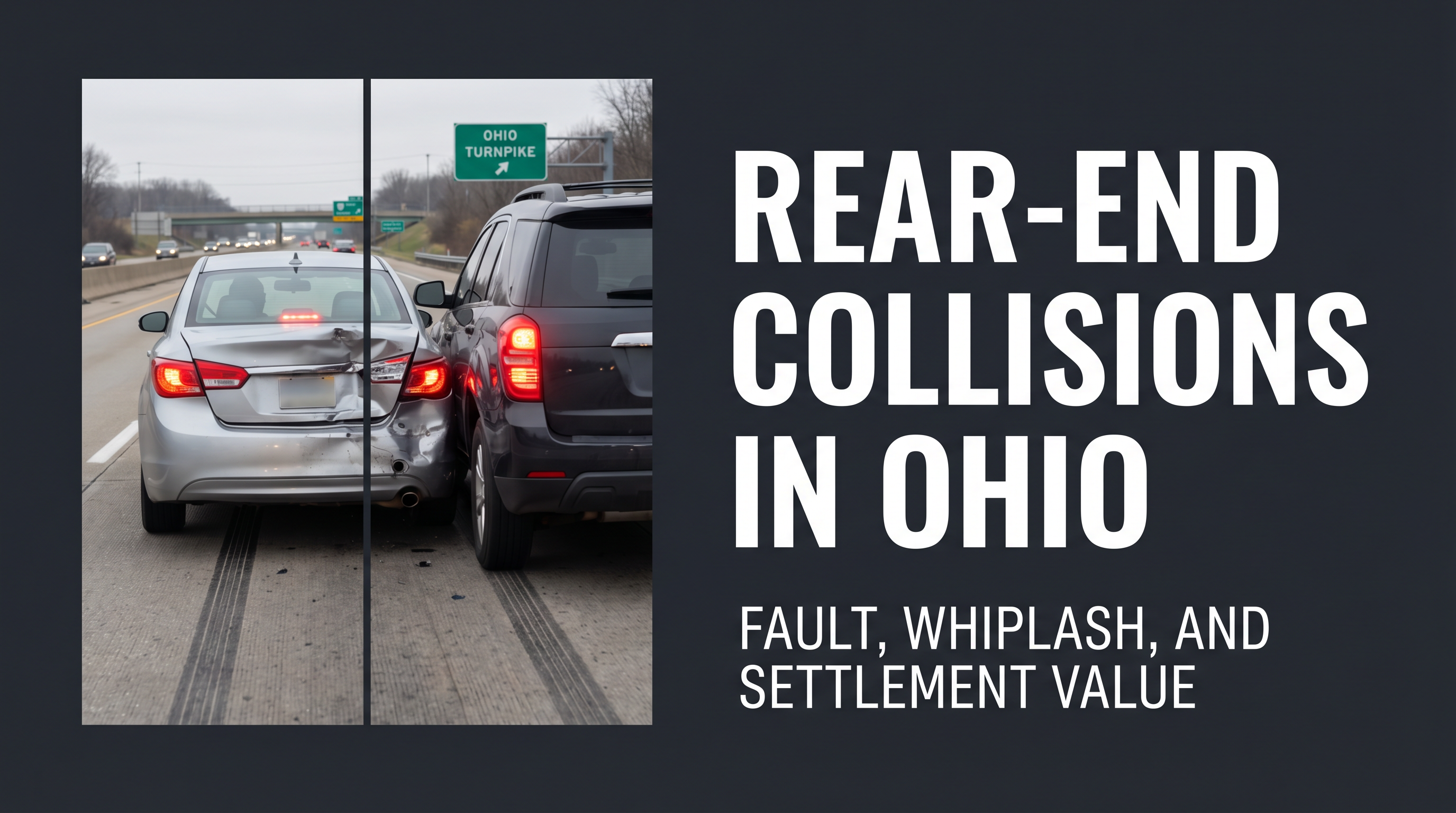
Rear-end collisions are the most frequent type of car accident in Ohio, accounting for nearly a third of all crashes. They happen daily on congested routes like I-480, at busy intersections in downtown Cleveland, and in stop-and-go traffic on local arteries. While insurance companies often dismiss rear-end crashes as "minor fender benders," the physical forces involved can cause severe, long-lasting injuries to the spine, neck, and brain. Understanding liability and how to prove your injuries is critical to securing fair compensation.
The Presumption of Fault in Rear-End Crashes
In Ohio, there is a strong legal presumption that the driver who rear-ends the vehicle in front of them is at fault for the collision. This presumption is based on Ohio Revised Code Section 4511.212, which requires drivers to maintain an "assured clear distance ahead."
This statute mandates that a driver must leave enough space between their vehicle and the vehicle in front of them to stop safely if the lead vehicle suddenly brakes. If a driver fails to maintain this distance and strikes the rear of another car, they have violated the statute and are generally considered negligent per se.
When the Rear Driver is NOT at Fault
While the rear driver is at fault in the vast majority of cases, the presumption is rebuttable. There are specific scenarios where the lead driver, or a third party, may be held liable under Ohio's comparative fault laws:
- Sudden, Unreasonable Stops: If the lead driver slams on their brakes for no justifiable reason (e.g., "brake checking" in a road rage incident), they may be found partially or entirely at fault.
- Reversing into Traffic: If a vehicle suddenly reverses out of a driveway or parking spot directly into the path of an oncoming car, the reversing driver is liable.
- Broken Taillights: If the lead vehicle's brake lights are completely non-functional, especially at night or in poor weather, the rear driver may argue they had no warning of the stop.
- Multi-Vehicle Chain Reactions: In a pileup, Car A stops safely. Car B stops safely behind Car A. Car C fails to stop, rear-ends Car B, and pushes Car B into Car A. In this scenario, Car C is liable for the damage to both Car A and Car B.
The Reality of Whiplash and Soft Tissue Injuries
The most common injury resulting from a rear-end collision is whiplash—a rapid, forceful back-and-forth jerking of the neck. Insurance adjusters are trained to view whiplash claims with extreme skepticism, often treating them as exaggerated or entirely fabricated.
However, medical science proves that whiplash is a severe injury. The violent snapping motion can tear ligaments, strain muscles, herniate cervical discs, and cause nerve damage. Symptoms often include chronic neck pain, severe headaches, numbness radiating down the arms, and cognitive difficulties. Crucially, these symptoms frequently do not appear until 24 to 48 hours after the crash, as adrenaline wears off and inflammation sets in.
The "Low-Impact" Defense Strategy
If your vehicle sustained minimal visible property damage (e.g., a scratched bumper), the insurance company will aggressively deploy the "low-impact" defense. They will argue that if the car was barely damaged, the occupants could not possibly be seriously injured.
This argument is scientifically flawed. Modern vehicle bumpers are designed to absorb low-speed impacts without crumpling. When the bumper does not crumple, the kinetic energy of the crash is transferred directly through the chassis and into the occupants' bodies. An experienced attorney will use biomechanical engineers and medical experts to explain to a jury exactly how a "minor" impact caused a major spinal injury.
Maximizing Your Rear-End Collision Claim
To defeat the insurance company's skepticism and secure maximum compensation, you must build an airtight case from day one:
- Seek Immediate Medical Care: Go to the ER or urgent care the same day. A documented medical evaluation immediately following the crash is the best defense against the insurance company's claim that you were not hurt.
- Follow All Medical Advice: Attend every physical therapy session, take prescribed medications, and follow up with specialists. Gaps in treatment will destroy your claim.
- Preserve Evidence: Obtain the police report, photograph the damage to both vehicles, and secure any dashcam footage.
- Do Not Settle Early: Never accept a settlement offer until your doctor confirms you have reached Maximum Medical Improvement (MMI). If you settle before you know the full extent of your injuries, you will pay for future medical care out of your own pocket.
Don't Let the Insurance Company Minimize Your Pain
Rear-end collisions may be common, but your injuries are unique and deserve to be taken seriously. Insurance companies will try to dismiss your pain as a "minor strain." We will not let them.
If you have suffered whiplash, a concussion, or spinal injuries in a rear-end crash in Cuyahoga County, contact Ryan Injury Attorneys today. We have the medical knowledge and litigation experience to prove the true severity of your injuries and demand the compensation you deserve. Call for a free consultation.
Frequently Asked Questions
What if the driver who rear-ended me says I stopped too fast?
This is a common excuse, but it rarely holds up in court. Under the "assured clear distance ahead" rule, the rear driver is legally obligated to leave enough space to stop safely, regardless of how abruptly you brake. Unless you were brake-checking them maliciously, they are almost certainly at fault.
How much is a whiplash settlement worth in Ohio?
There is no "average" settlement for whiplash. The value of your claim depends entirely on the severity of the injury, the length of your medical treatment, whether you suffered permanent nerve damage or disc herniations, and how much work you missed. A minor strain may settle for a few thousand dollars, while a severe cervical injury requiring surgery can be worth six figures.
Do I need an MRI to prove I have whiplash?
While an X-ray will only show bone fractures, an MRI is critical for diagnosing soft tissue injuries like torn ligaments or herniated discs, which are the root cause of severe whiplash pain. Your attorney will work with your doctors to ensure you receive the proper diagnostic imaging to prove your case.
Can I claim compensation for a concussion from a rear-end crash?
Yes. You do not have to hit your head on the steering wheel to suffer a concussion. The violent whipping motion of a rear-end crash can cause your brain to strike the inside of your skull, resulting in a Traumatic Brain Injury (TBI). Concussions are serious injuries that warrant significant compensation.
What if the rear driver fled the scene?
If you are rear-ended and the driver commits a hit-and-run, you should immediately pull over, call 911, and provide the police with any identifying information you have (license plate, vehicle description). You can then pursue a claim under your own Uninsured Motorist (UM) coverage to pay for your medical bills and damages.