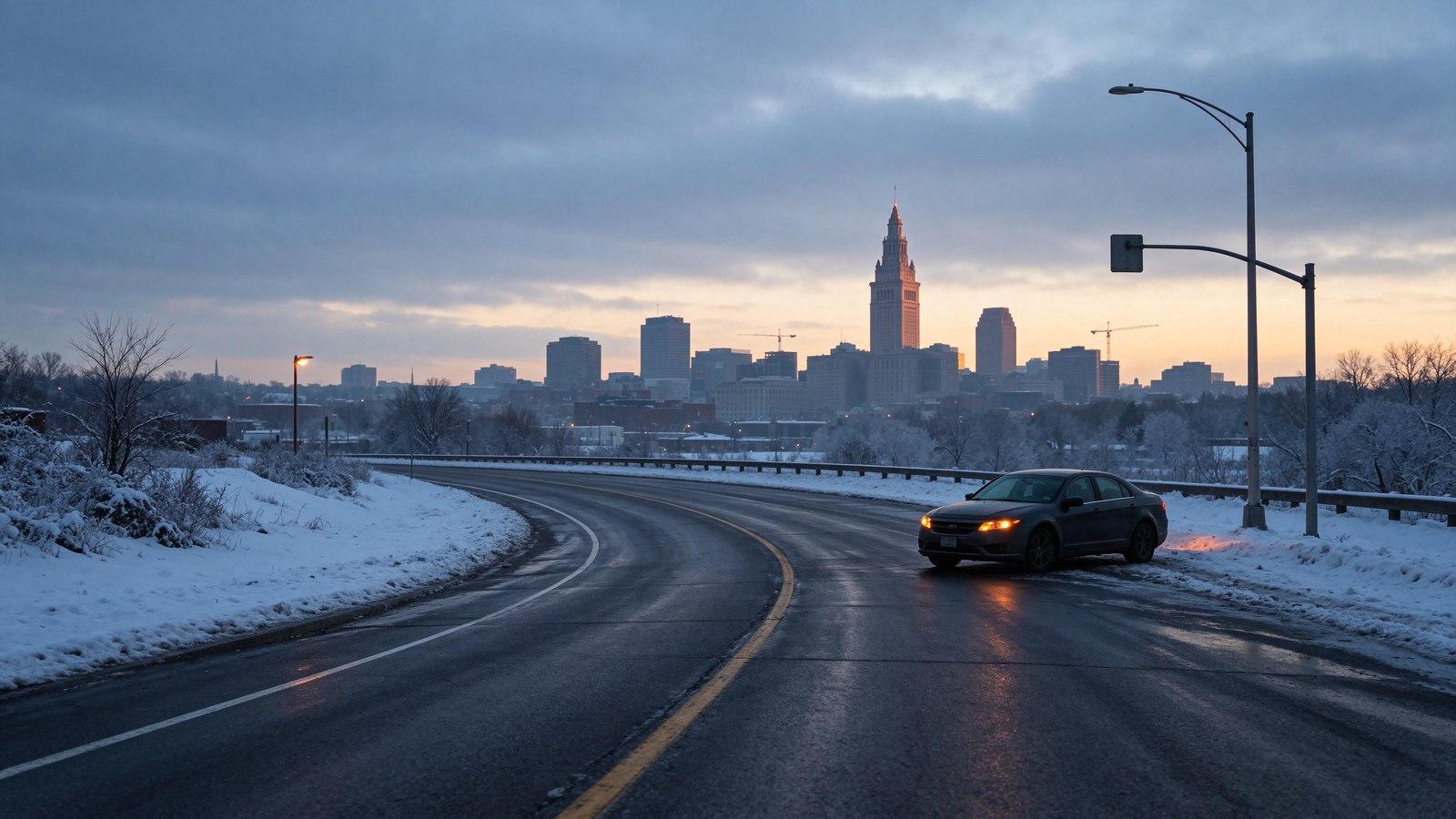
Hero image: AI-generated illustration, not a photograph of an actual collision or a specific crash location.
A driver slides through an intersection, crosses a lane, or strikes the vehicle ahead. Afterward, the explanation is simple: “There was black ice.” For an injured person, the next question is more difficult. Does that mean nobody is responsible?
Not necessarily. Black ice does not automatically excuse unsafe driving under Ohio law. Drivers must choose a reasonable speed and following distance for the conditions. But a skid or collision alone does not automatically establish negligence, either. A claim depends on what each driver did, what conditions existed, and whether a breach of a legal duty caused the injury.
For Cleveland drivers, those questions can arise on an interstate ramp, an elevated bridge, or a neighborhood intersection after a thaw and overnight freeze. The road may look wet rather than icy. Understanding the difference between a weather hazard and a driver's response to it helps explain how fault is evaluated.
Why black ice can be difficult to recognize in Cleveland
The National Weather Service describes black ice as patchy ice on transportation surfaces that cannot easily be seen. It is often clear, allowing the dark pavement underneath to remain visible. That appearance can make a frozen road resemble a wet one. Black ice can form when snowmelt refreezes overnight or when rain is followed by below-freezing temperatures. Bridges and overpasses can freeze before other surfaces. 1
That matters on a Cleveland-area trip with several changes in road elevation and exposure. For example, pavement approaching a bridge may appear different from the bridge deck itself. A trip along I-90, I-71, or I-480 can also involve ramps, curves, and traffic queues that leave less room to respond to a loss of traction. These are examples of conditions to evaluate, not claims that a particular interchange has the most ice-related crashes.
Lake-effect snow adds another layer of uncertainty. According to the National Weather Service, heavy snow may fall in one place while the sun shines a mile or two away. Conditions at the start of a trip therefore may not describe the conditions encountered later. 2
For drivers traveling between Cleveland, Lakewood, Euclid, or other Cuyahoga County communities, the practical lesson is to check conditions along the route and allow for changes. For an injury claim, the lesson is different: document the conditions at the actual crash location and time, rather than relying only on a regional forecast.
What Ohio law requires on icy roads
A posted speed limit is not a guarantee of a safe speed
R.C. 4511.21(A) prohibits driving at a speed greater or less than is reasonable or proper, considering traffic, the road surface and width, and other conditions. It also prohibits driving faster than permits a stop within the assured clear distance ahead. 3
On an icy road, a speed that was reasonable on dry pavement may no longer be reasonable. A driver who says, “I was under the limit,” has not answered every question about safe operation. The relevant inquiry includes the surface, visibility, traffic ahead, and the driver's opportunity to respond.
The statute does not establish one speed that is safe for every icy road. Nor does its text resolve every legal question about assured clear distance. Applying the rule to a particular collision requires the facts, including what was ahead of the vehicle and how the event unfolded.
Following distance must reflect the conditions
Under R.C. 4511.34(A), a driver must not follow another vehicle more closely than is reasonable and prudent, considering speed, traffic, and highway conditions. 4
The National Highway Traffic Safety Administration recommends slowing down on slick surfaces and increasing following distance to leave more time to stop. That is safety guidance consistent with the need to consider conditions, not a fixed statutory formula. 5
In a winter rear-end collision, an investigation may ask whether the following driver left enough room, when traffic began slowing, and whether the vehicle was pushed forward by another impact. The position of a vehicle after the crash does not necessarily tell the whole story.
How fault is evaluated after a black-ice crash
An injury claim generally requires proof of a duty, a breach of that duty, and injuries caused by the breach. The presence of ice is part of that analysis. It is not a substitute for it.
Useful evidence may include a driver's speed before losing traction, the distance between vehicles, visible road conditions, weather warnings, witnesses' observations, and the sequence of impacts. Vehicle condition may also matter if there is evidence that a maintenance problem contributed. No single fact should be treated as decisive without considering the rest of the record.
What if the driver says the ice was impossible to anticipate?
A driver may argue that unexpectedly encountering black ice created a sudden emergency. Whether that argument applies is fact-specific. It should not be accepted or rejected solely because someone used the words “black ice.”
The review should distinguish an unexpected condition from circumstances a driver reasonably should have accounted for. For example, evidence of freezing temperatures, visible ice nearby, or vehicles already sliding may bear on whether additional precautions were warranted. Those facts still do not guarantee a particular legal result.
The important distinction: Weather can help explain why a crash happened. It does not automatically decide whether a driver acted reasonably or whether that conduct caused an injury.
Can more than one driver share responsibility?
Yes. An icy-road collision may involve several drivers, separate impacts, and different opportunities to avoid a crash.
Under R.C. 2315.33, an injured person's contributory fault does not bar recovery unless it is greater than the combined fault of the other responsible persons. Recoverable compensatory damages are reduced by the injured person's percentage of fault. In ordinary percentage terms, fault of 50 percent or less does not itself bar recovery; fault above 50 percent does. 6
In a multi-vehicle crash, the comparison is not necessarily just between the injured person and one other driver. Identifying the full sequence matters. Our Ohio comparative-fault guide explains the general rule in more detail.
What to do after an icy-road collision
Put medical care and roadside safety first
Call 911 for injuries or an immediate danger. Follow emergency responders' instructions. Do not stand in a travel lane or walk onto a slippery roadway to inspect the surface or take a photograph. Another approaching vehicle may lose control in the same area.
Seek appropriate medical evaluation and follow treatment recommendations. Tell your providers how the collision occurred and accurately describe your symptoms. Keep copies of records, bills, and work restrictions as they become available.
Preserve the conditions, not just the vehicle damage
If it is safe, capture photographs or video from a protected location. Useful details can include the vehicles, nearby signs, the road surface, snow along the shoulder, and the surrounding intersection or ramp. Record the exact time, travel direction, and location. Do not return to a dangerous scene solely to gather evidence.
Save original dashcam files rather than only a shortened or compressed clip. Retain witness contact information and your own factual notes. If a nearby business or vehicle may have recorded the collision, a prompt preservation request can be important because retention periods vary.
A temperature reading from a distant weather station does not necessarily establish the pavement condition at the scene. Weather records, road-condition reports, and photographs may need to be considered together.
Keep the report and your claim records organized
Ask the investigating agency how to obtain the crash report. A report can provide useful observations, diagrams, and contact information, but it does not by itself resolve every civil-liability question.
Notify your insurer promptly as required by your policy. Give accurate information and distinguish what you personally observed from what you learned later. Keep claim numbers, correspondence, medical bills, repair documents, and records of missed work together. Before signing a release, understand whether it resolves property damage, bodily injury, or both.
For a broader checklist, see what to do after a car accident in Ohio.
Insurance coverage and filing deadlines
If another driver's negligence caused your injury, a claim may be available against that driver and applicable liability coverage. Recoverable losses depend on the evidence and applicable law. They may include medical expenses, lost income, and other injury-related damages; no particular payment is guaranteed.
Your own insurance may also matter. Collision coverage can address vehicle damage, subject to the policy and deductible. Medical payments coverage, if included, may help with eligible medical expenses. These coverages are distinct from proving that another driver is legally responsible.
Uninsured motorist coverage is not automatic
R.C. 3937.18 allows uninsured and underinsured motorist coverage but does not require every Ohio policy to include it. Coverage depends on the policy, applicable law, and proof supporting a claim against a legally responsible motorist. 7
A single-vehicle skid on ice does not, by itself, create an uninsured motorist claim. Likewise, underinsured motorist coverage is not a promise to pay every remaining dollar of a loss. Limits, exclusions, insured status, and claims requirements need review. Learn more in our Ohio uninsured-motorist coverage guide.
The ordinary injury deadline is generally two years
Under R.C. 2305.10(A), an ordinary Ohio bodily-injury lawsuit generally must be filed within two years after the claim accrues. For a typical crash injury, that generally means when the injury occurs, usually the crash date. Exceptions and different claim types can change the deadline. 8
Insurance policies may impose separate notice or claims requirements. An ongoing insurance discussion should not be assumed to extend a lawsuit deadline. Have the dates checked promptly rather than waiting until the end of the ordinary filing period.
Can a city be responsible for an icy road?
An untreated road does not automatically mean Cleveland, another municipality, or a state agency is liable. The responsible entity, the claimed maintenance failure, government immunity, and any applicable exception require separate analysis.
R.C. 2744.02 generally provides immunity for political subdivisions and describes certain exceptions, including a public-road repair and obstruction exception. The presence of black ice does not automatically establish that the exception applies. State-agency claims involve a different legal framework. 9
A driver claim and a government-maintenance claim therefore should not be treated as interchangeable. Evidence of an icy road may be relevant to both, but it does not establish a viable government claim by itself.
Frequently asked questions
Is the other driver automatically at fault if they slid on black ice?
No. A skid alone does not automatically prove negligence. Fault depends on the driver's conduct, the conditions, the applicable legal duties, and whether a breach caused the injury. Black ice also does not automatically excuse unsafe speed or following distance.
Can a driver be responsible even if they were below the speed limit?
Yes, depending on the facts. R.C. 4511.21(A) requires a speed that is reasonable for traffic, the road surface, and other conditions. A speed below the posted limit can still be unsafe on an icy road.
Can I recover if I was partly responsible for the crash?
Possibly. Under R.C. 2315.33, your fault must not be greater than the combined fault of the other responsible persons. Recoverable compensatory damages are reduced by your percentage of fault. Being partly responsible does not necessarily eliminate the claim.
Does Ohio law require uninsured motorist coverage?
No. R.C. 3937.18 permits uninsured and underinsured motorist coverage but does not require every policy to include it. Check the actual policy for coverage, limits, exclusions, and claims requirements.
What evidence should I save after a black-ice collision?
Save original photos and video, witness contact information, the exact crash time and location, the crash report, medical records, and insurance correspondence. Photograph road conditions only from a safe location. Never enter a travel lane to gather evidence.
How long do I have to file an Ohio injury lawsuit?
An ordinary car-crash bodily-injury lawsuit generally has a two-year accrual-based deadline under R.C. 2305.10(A). Exceptions, different claims, and insurance-policy requirements can change the relevant dates. Have the deadline checked for your circumstances.
Cleveland-area winter road resources
Before traveling, check OHGO for traffic cameras, incidents, closures, and road-condition information, and NWS Cleveland for forecasts and alerts. Conditions can change after you check, so neither replaces attention to the road. ODOT links these travel tools from its Snow & Ice page. 10
For vehicle preparation, NHTSA's winter-driving guidance recommends checking tires and other equipment, carrying emergency supplies, giving snowplows room, and considering postponement of nonessential travel when roads are unsafe. 5
These resources support safer decisions. They do not determine civil fault in a particular crash.
Discuss your crash with Ryan Injury Attorneys
If you were injured in a Cleveland-area winter collision, Ryan Injury Attorneys can review the facts, discuss potential insurance coverage, and help identify evidence that may need preservation. A consultation can address whether the available facts support a claim and which deadlines need attention.
Thomas P. Ryan is an Ohio personal injury trial attorney. Learn about Ryan Injury Attorneys and our Cleveland car-accident representation. The firm's office is at 55 Public Square, Suite 2100, Cleveland, OH 44113. This website is operated by Ryan LLP.
Call (216) 363-6040 or request a case review.
This article provides general information about Ohio law, not legal advice for a particular matter. Reading it or contacting the firm does not by itself create an attorney-client relationship. Each case depends on its facts, applicable law, insurance coverage, and deadlines. No outcome is guaranteed.
References
- National Weather Service, Ice Storms and Black Ice
- National Weather Service, Lake Effect Snow
- Ohio Revised Code 4511.21, Reasonable Speed and Assured Clear Distance
- Ohio Revised Code 4511.34, Space Between Moving Vehicles
- NHTSA, Winter Weather Driving Tips
- Ohio Revised Code 2315.33, Comparative Fault
- Ohio Revised Code 3937.18, Uninsured and Underinsured Motorist Coverage
- Ohio Revised Code 2305.10, Bodily Injury Filing Period
- Ohio Revised Code 2744.02, Political Subdivision Liability and Immunity
- Ohio Department of Transportation, Snow and Ice